Back

Fastrack Case Study

Sharon Pradeep

Back

Fastrack Case Study

Back

Fastrack Case Study

Fastrack

Fashion

Ecommerce

Web

Fastrack, a sub-brand of Titan Watches, is widely recognized for its youthful, fashion-forward identity in the Indian market.However, despite its strong brand presence, the Fastrack website has struggled to translate this identity into an engaging online experience.

Fastrack

Fashion

Ecommerce

Web

Fastrack, a sub-brand of Titan Watches, is widely recognized for its youthful, fashion-forward identity in the Indian market.However, despite its strong brand presence, the Fastrack website has struggled to translate this identity into an engaging online experience.

Fastrack

Fashion

Ecommerce

Web

Fastrack, a sub-brand of Titan Watches, is widely recognized for its youthful, fashion-forward identity in the Indian market.However, despite its strong brand presence, the Fastrack website has struggled to translate this identity into an engaging online experience.

Project insights

My Role
  • UX research

  • Analysis and Visual design

The Team
  • 4 designers (incl. me)

  • Titan Design head, myself, 1 UI designer, 1 design intern

Results
  • 📉 Cart abandonment reduced 91.76% → 72.53%

  • 📈 PDP visits increased 30.67% → 57.4%

  • 📉 Cart abandonment reduced 91.76% → 72.53%

  • 📈 PDP visits increased 30.67% → 57.4%

The Problem

Fastrack is bold, playful, and youth-centric, but its website didn’t reflect that energy.


Despite high time spent on site, users weren’t discovering products or converting. The experience felt cluttered, unclear, and emotionally disconnected.

Design Challenge

How might we create an engaging online experience for Fastrack that balances creativity and practicality while staying true to its vibrant, youthful brand identity and driving conversions?

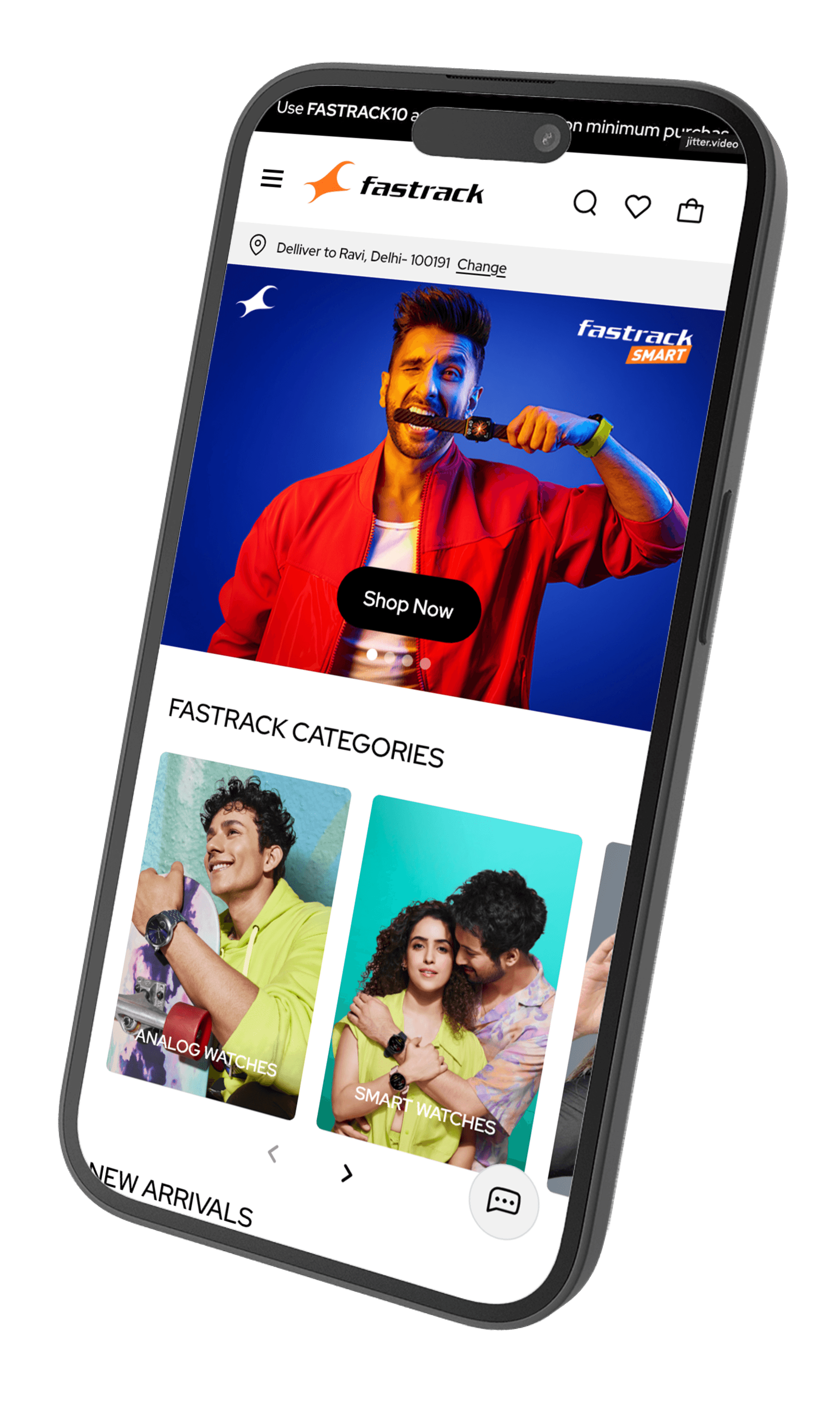
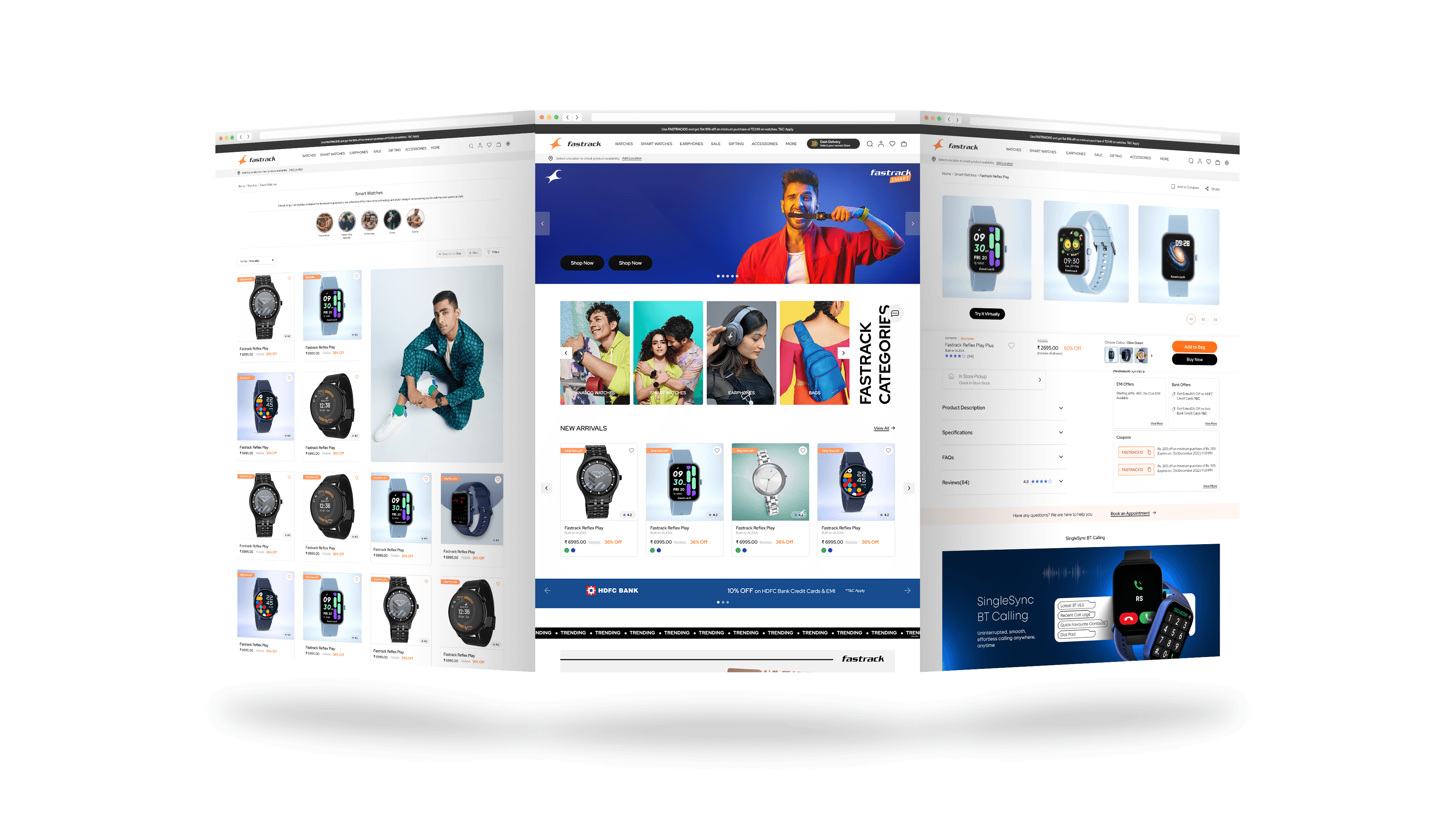
Overview of the redesigned experience

Overview of the redesigned experience

The Process

We kicked off the process with a comprehensive experience review of the current experience.

The target audience of Fastrack is essentially young audience within the age group 18 to 32. So our study focused on that particular age demography.


We decided to go with 3 methods of data collection, and 4 other methods to understand common e-commerce practices, trends and performance of the current website. 

  1. Desk research
  1. User interviews
  1. User survey
  1. Store interviews
  1. Web analytics
  1. Heuristics evaluation
  1. Benchmarking
Designing for different shoppers

None of us had prior e-commerce experience except for the Titan design head. It was crucial for all team members to grasp common e-commerce practices.


We conducted desk research to comprehend typical user behaviors and UX practices.
Designing for different type of shoppers

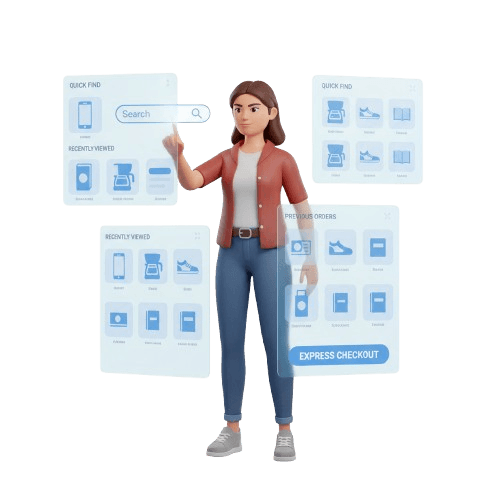
Product Focused Shoppers
What they want?
  • Clearly identifying each product offering

  • Search that makes it easy to locate items of interest

  • Checkout process to make it as quick as possible

  • Easy access to items previously visited or purchased

  • Checkout process to make it as quick as possible

I’ve been eyeing this model for week, just need to check if the specs match my requirements.

Designing for different type of shoppers

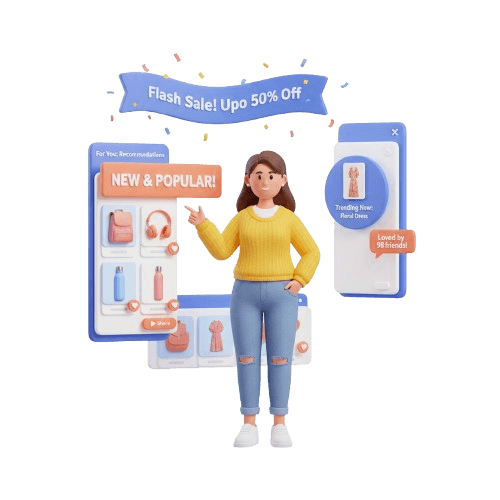
Casual Shoppers
What they want?
  • Highlighting new, popular, or on-sale products

  • Pointing to new inventory through relevancy and recommendations

  • Supporting the sharing of information about products they like

  • Creating relevant, unique, and attention-grabbing product categories

Oh, that looks cute! I wasn’t planning to buy, but maybe I’ll just check the price.

Designing for different type of shoppers

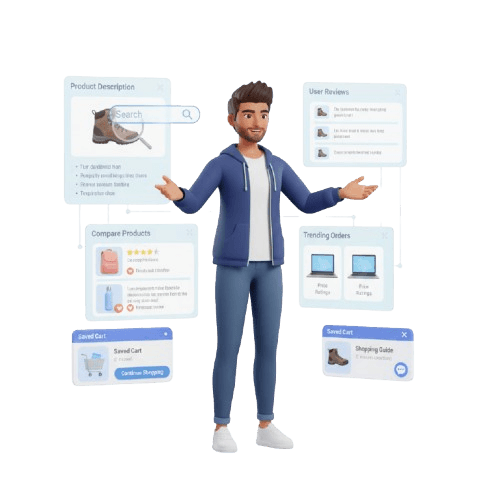
Researchers
What they want?
  • Providing clear and detailed product descriptions

  • Providing robust user reviews

  • Easy comparisons between products

  • Saving users’ shopping carts to allow shopping to continue

  • Including product guides and shopping assistance tools

How does this compare with the other brand?

Designing for different type of shoppers

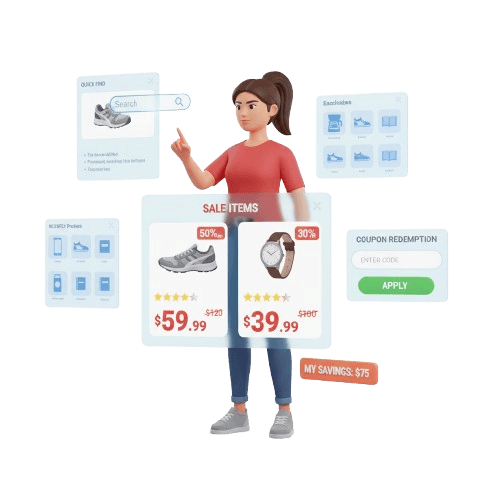
Bargain Hunters
What they want?
  • Listing sale items alongside full priced inventory and providing an obvious section for discounted products

  • Clearly listing product prices and associated discounts and savings

  • Allowing easy coupon redemption

This is nice, but I’ll wait for the price to drop further.

Designing for different type of shoppers

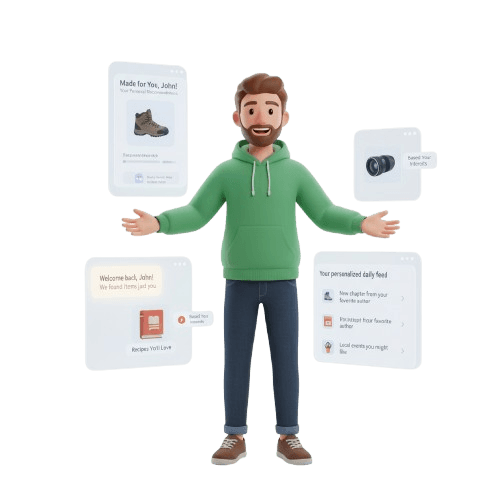
Personalized Browsing Experience
What they want?
  • If executed correctly, personalization will help users feel valued and accommodated by an experience that is uniquely relevant to them

  • When personalization is executed incorrectly, users will feel annoyed by experiences that don’t match what they expect.

I like when products are picked just for me.

Designing for different type of shoppers

Product Focused Shoppers
What they want?
  • Clearly identifying each product offering

  • Search that makes it easy to locate items of interest

  • Checkout process to make it as quick as possible

  • Easy access to items previously visited or purchased

  • Checkout process to make it as quick as possible

Designing for different type of shoppers

Casual Shoppers
What they want?
  • Highlighting new, popular, or on-sale products

  • Pointing to new inventory through relevancy and recommendations

  • Supporting the sharing of information about products they like

  • Creating relevant, unique, and attention-grabbing product categories

Designing for different type of shoppers

Researchers
What they want?
  • Providing clear and detailed product descriptions

  • Providing robust user reviews

  • Easy comparisons between products

  • Saving users’ shopping carts to allow shopping to continue

  • Including product guides and shopping assistance tools

Designing for different type of shoppers

Bargain Hunters
What they want?
  • Listing sale items alongside full priced inventory and providing an obvious section for discounted products

  • Clearly listing product prices and associated discounts and savings

  • Allowing easy coupon redemption

Designing for different type of shoppers

Personalized Browsing Experience
What they want?
  • If executed correctly, personalization will help users feel valued and accommodated by an experience that is uniquely relevant to them

  • When personalization is executed incorrectly, users will feel annoyed by experiences that don’t match what they expect.

Designing for different type of shoppers

Product Focused Shoppers
What they want?
  • Clearly identifying each product offering

  • Search that makes it easy to locate items of interest

  • Checkout process to make it as quick as possible

  • Easy access to items previously visited or purchased

  • Checkout process to make it as quick as possible

Designing for different type of shoppers

Casual Shoppers
What they want?
  • Highlighting new, popular, or on-sale products

  • Pointing to new inventory through relevancy and recommendations

  • Supporting the sharing of information about products they like

  • Creating relevant, unique, and attention-grabbing product categories

Designing for different type of shoppers

Researchers
What they want?
  • Providing clear and detailed product descriptions

  • Providing robust user reviews

  • Easy comparisons between products

  • Saving users’ shopping carts to allow shopping to continue

  • Including product guides and shopping assistance tools

Designing for different type of shoppers

Bargain Hunters
What they want?
  • Listing sale items alongside full priced inventory and providing an obvious section for discounted products

  • Clearly listing product prices and associated discounts and savings

  • Allowing easy coupon redemption

Designing for different type of shoppers

Personalized Browsing Experience
What they want?
  • If executed correctly, personalization will help users feel valued and accommodated by an experience that is uniquely relevant to them

  • When personalization is executed incorrectly, users will feel annoyed by experiences that don’t match what they expect.

User interviews, survey
and store manager interviews
User interviews, survey and store manager interviews

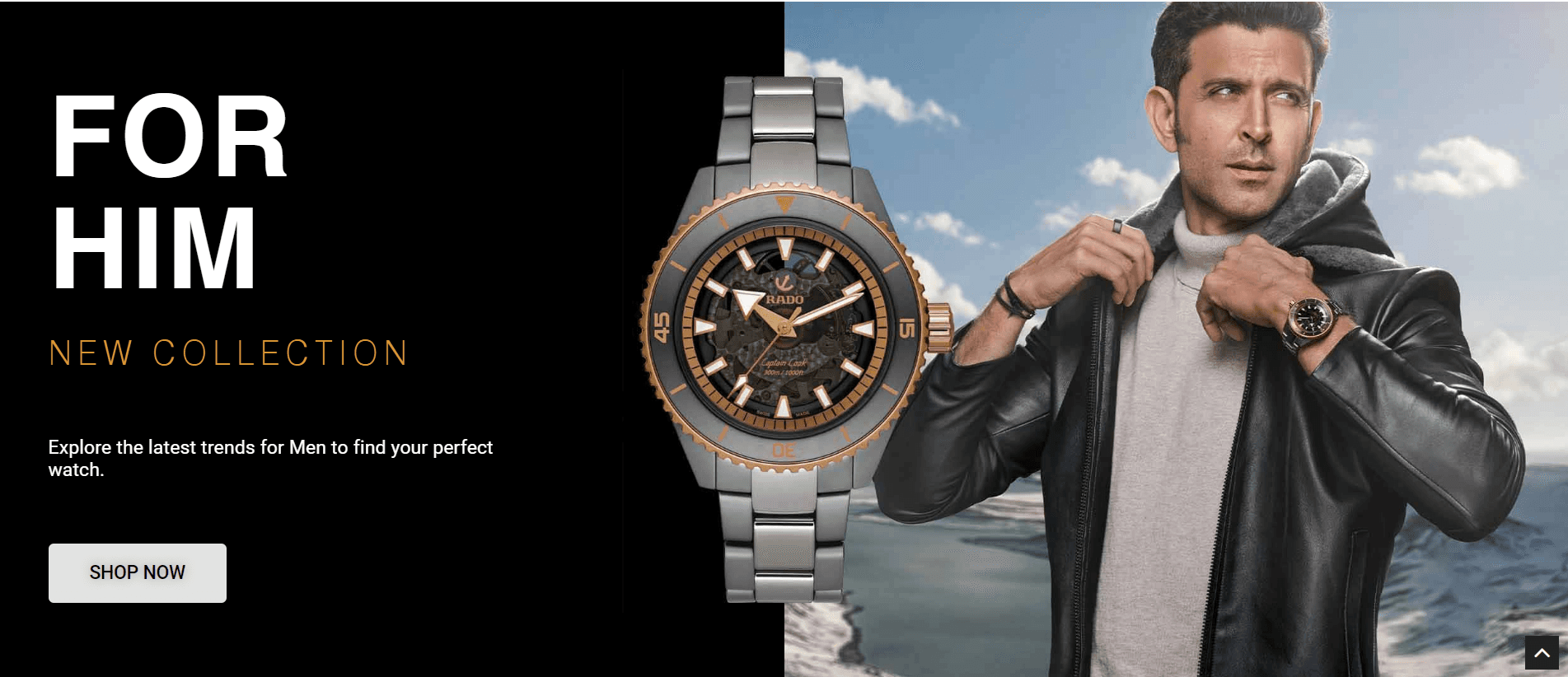
After gaining a basic understanding of e-commerce in general, we began to delve deeper into insights specific to watch brands, Fastrack's target audience, and its competitors through surveys, interviews, and benchmarking.
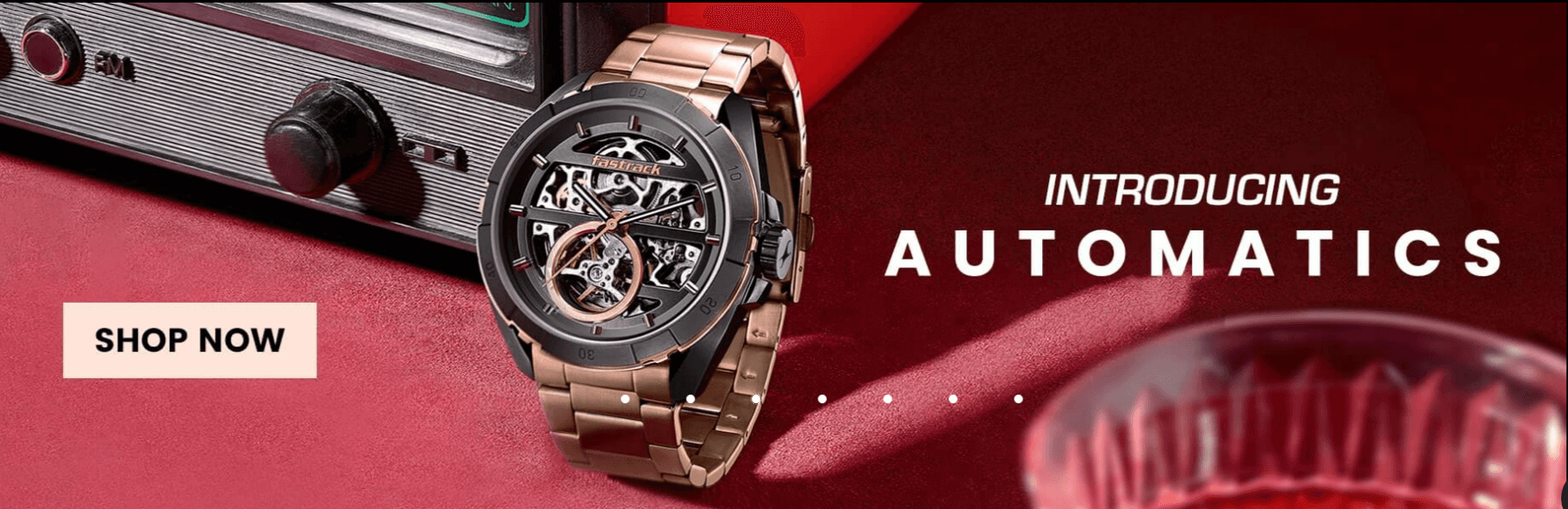
  1. Watch as a status symbol

  • 50% of customers consider watches as a symbol of their social status.

  • This is reinforced by the branding strategies of competitors. They clearly showcases how purchasing this specific brand sets individuals apart from the crowd and help enhancing their social status.

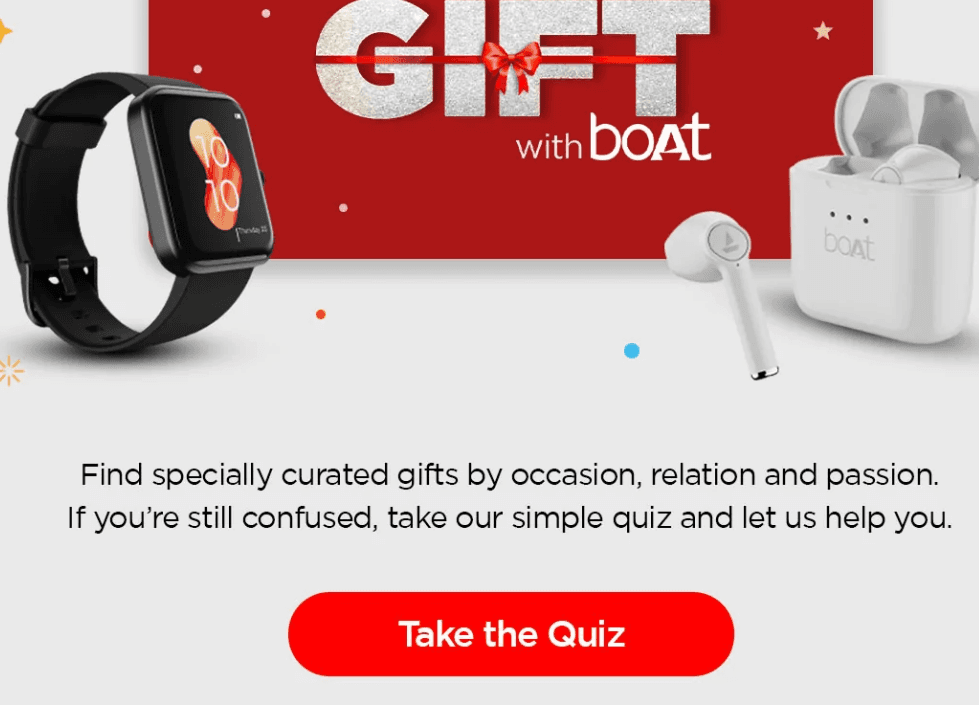
Product showcase - Fastrack vs Competitors

VS

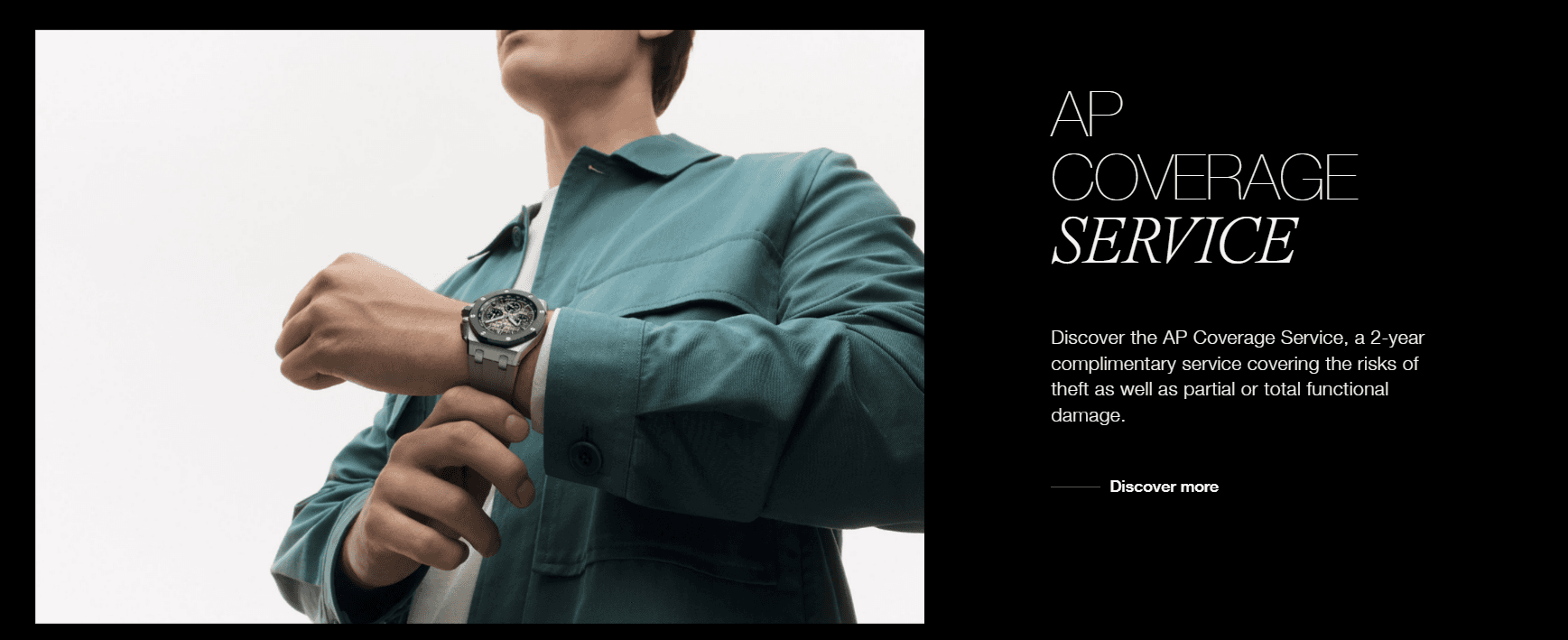
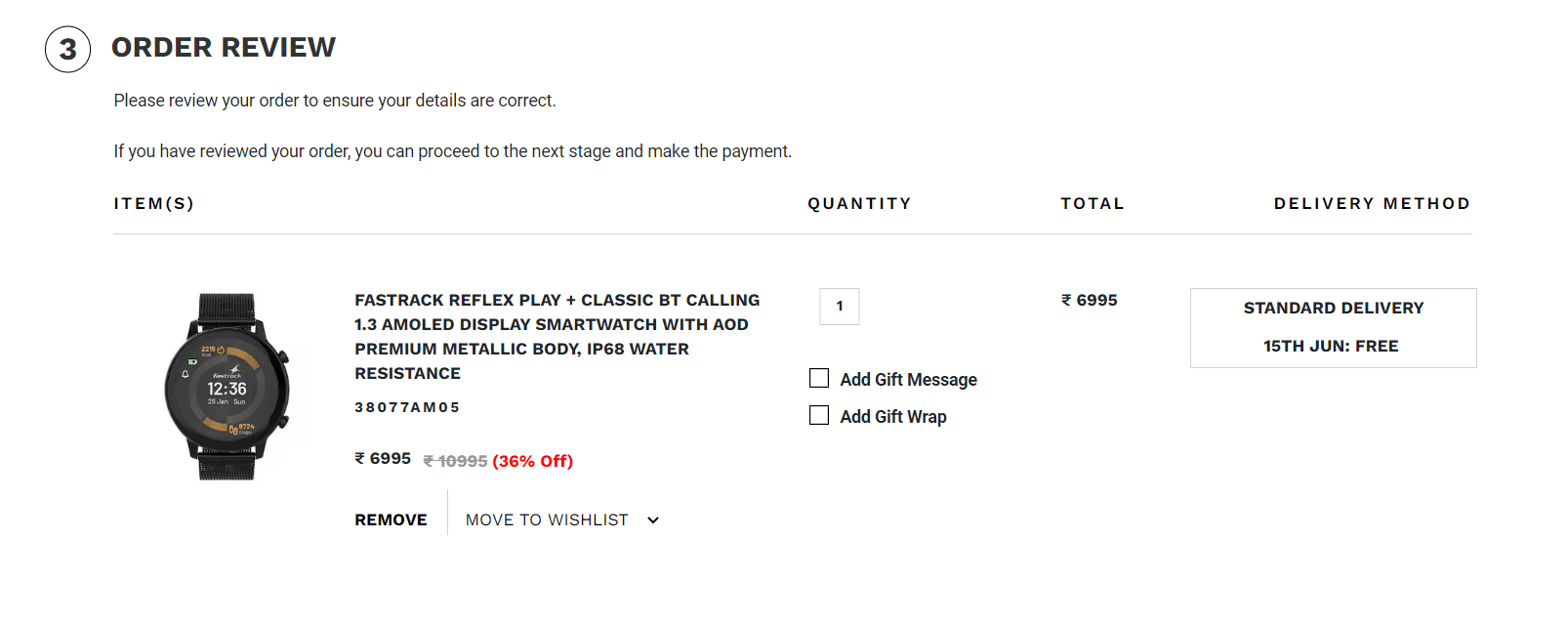
  1. Watch as a meaningful gift

  • 30% of respondents see watches as ideal gifts, with store managers confirming that over 50% of purchases are for gifting.

  • Currently, Fastrack lacks a dedicated gifting section, with the only option being gift wrap at the checkout.

Gift showcase - Fastrack vs Competitors

VS

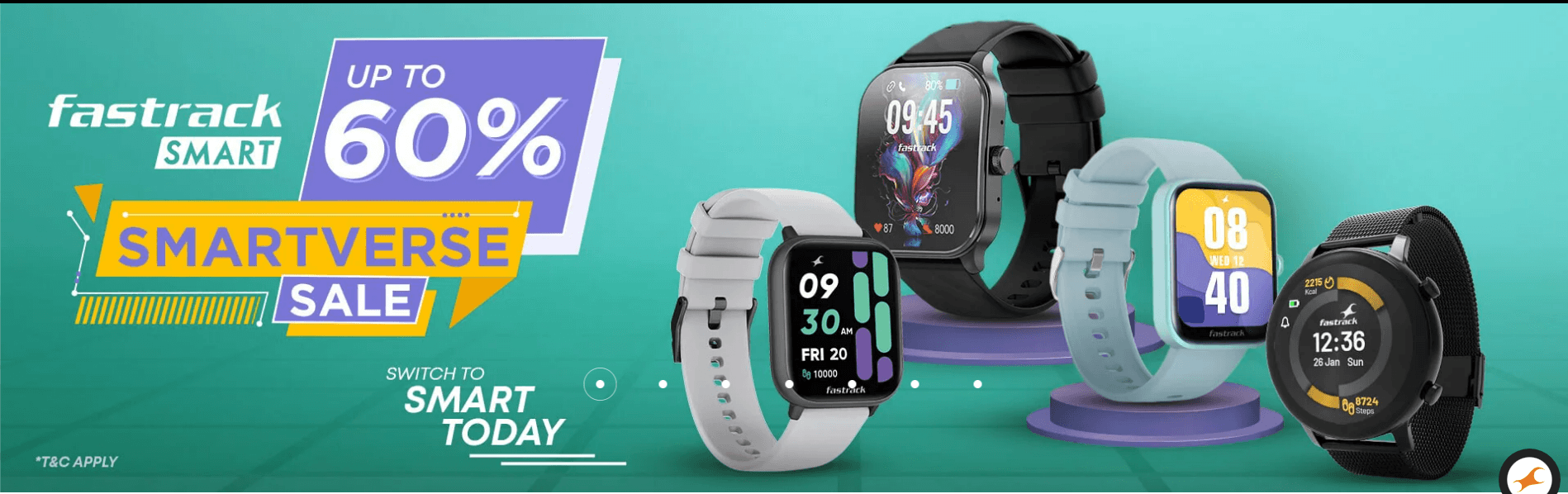
  1. Smart watches are the item in demand

  • Smartwatches are the best-selling product, but store managers in Kozhikode and Bangalore report frequent complaints.

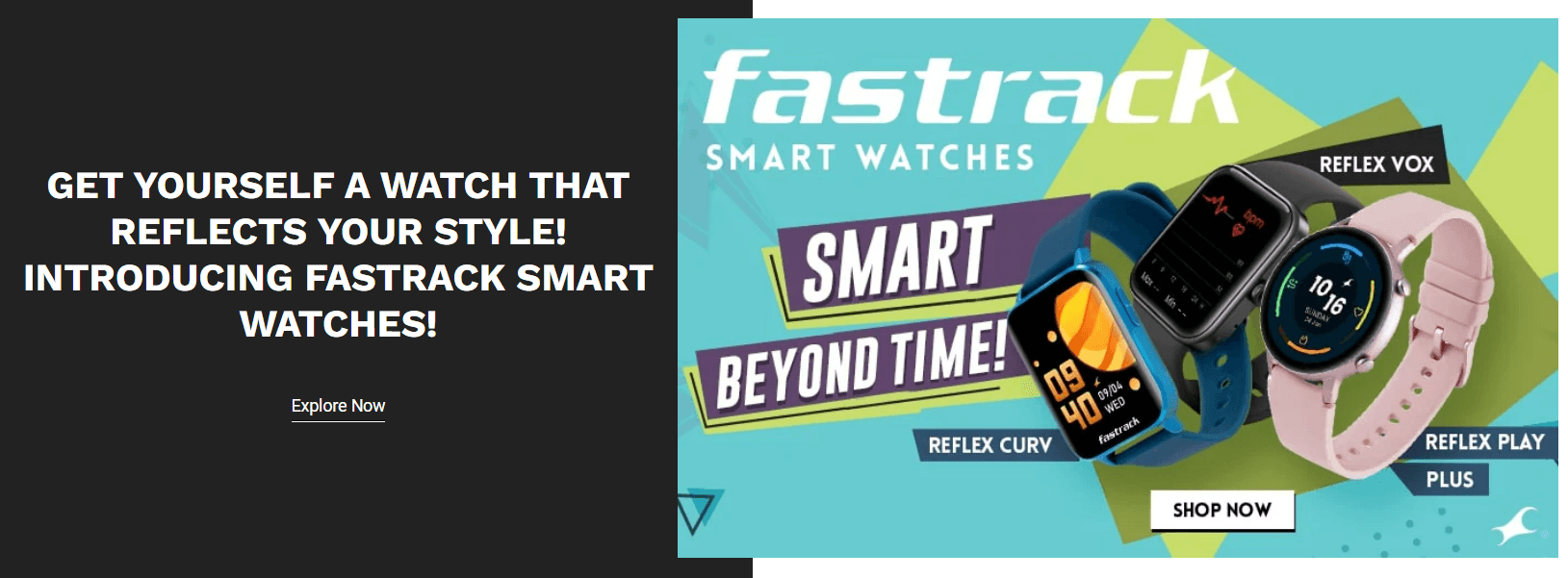
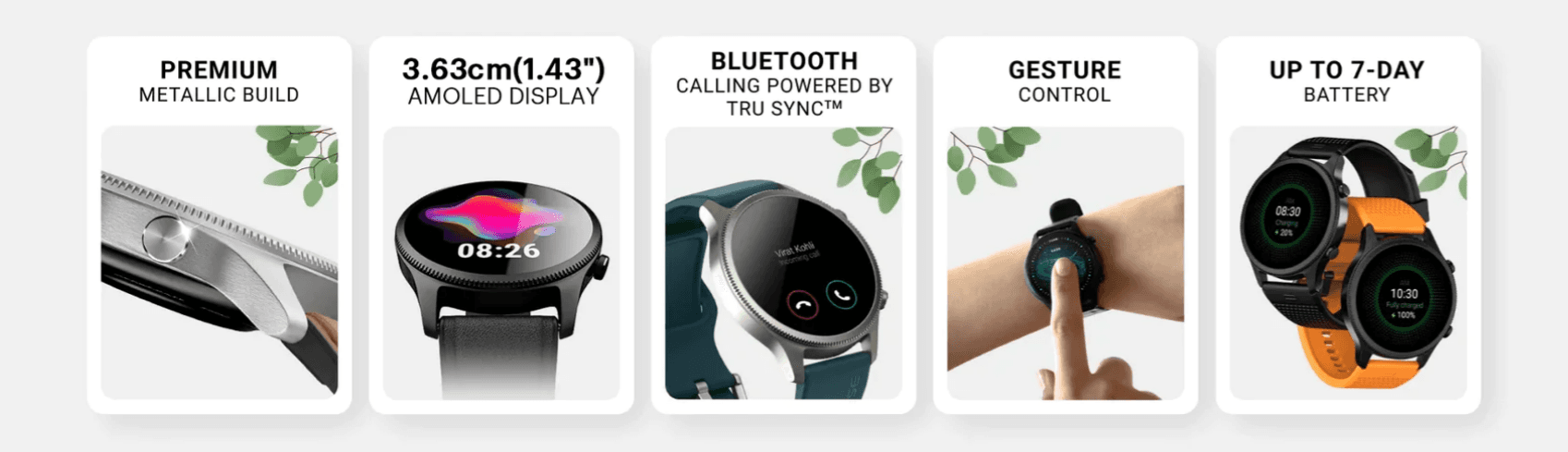
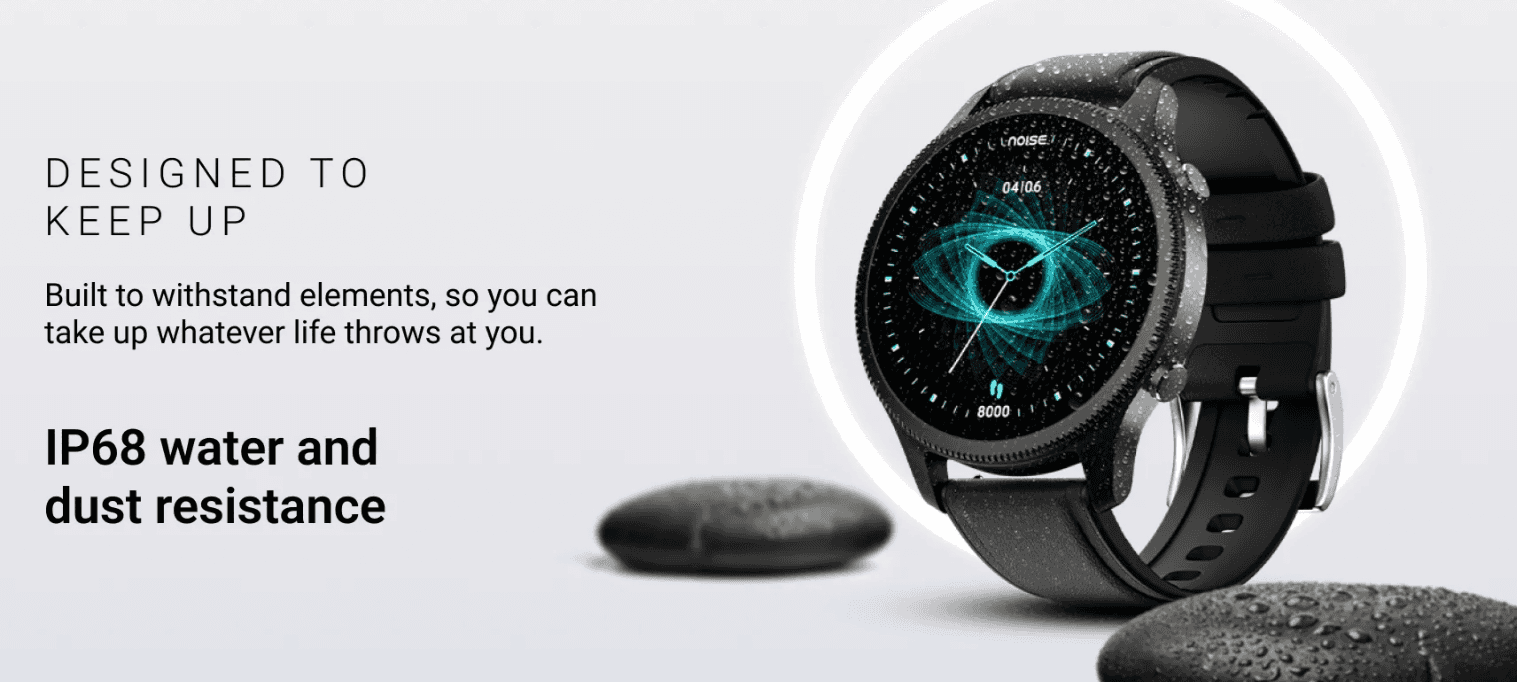
  • Customers actively compare Fastrack’s smartwatches with brands like Noise, Fire-Boltt, and Boat, signaling a need for quality improvements and competitive positioning.

Smartwatch showcase - Fastrack vs Competitors

VS

  1. People prefer buying from brand website

  • 70% of customers prefer buying from official brand websites, though this data may be skewed, Store managers emphasize Fastrack’s brand trust and service as key USPs.

  • These USPs should be prominently highlighted throughout the website to enhance customer confidence.

USP showcase - Fastrack vs Competitors

  1. Watch as a status symbol

  • 50% of customers consider watches as a symbol of their social status.

  • This is reinforced by the branding strategies of competitors. They clearly showcases how purchasing this specific brand sets individuals apart from the crowd and help enhancing their social status.

Product showcase - Fastrack vs Competitors

VS

  1. Watch as a meaningful gift

  • 30% of respondents see watches as ideal gifts, with store managers confirming that over 50% of purchases are for gifting.

  • Currently, Fastrack lacks a dedicated gifting section, with the only option being gift wrap at the checkout.

Gift showcase - Fastrack vs Competitors

VS

  1. Smart watches are the item in demand

  • Smartwatches are the best-selling product, but store managers in Kozhikode and Bangalore report frequent complaints.

  • Customers actively compare Fastrack’s smartwatches with brands like Noise, Fire-Boltt, and Boat, signaling a need for quality improvements and competitive positioning.

Smartwatch showcase - Fastrack vs Competitors

VS

  1. People prefer buying from brand website

  • 70% of customers prefer buying from official brand websites, though this data may be skewed, Store managers emphasize Fastrack’s brand trust and service as key USPs.

  • These USPs should be prominently highlighted throughout the website to enhance customer confidence.

USP showcase - Fastrack vs Competitors

  1. Watch as a status symbol

  • 50% of customers consider watches as a symbol of their social status.

  • This is reinforced by the branding strategies of competitors. They clearly showcases how purchasing this specific brand sets individuals apart from the crowd and help enhancing their social status.

Product showcase - Fastrack vs Competitors

VS

  1. Watch as a meaningful gift

  • 30% of respondents see watches as ideal gifts, with store managers confirming that over 50% of purchases are for gifting.

  • Currently, Fastrack lacks a dedicated gifting section, with the only option being gift wrap at the checkout.

Gift showcase - Fastrack vs Competitors

VS

  1. Smart watches are the item in demand

  • Smartwatches are the best-selling product, but store managers in Kozhikode and Bangalore report frequent complaints.

  • Customers actively compare Fastrack’s smartwatches with brands like Noise, Fire-Boltt, and Boat, signaling a need for quality improvements and competitive positioning.

Smartwatch showcase - Fastrack vs Competitors

VS

  1. People prefer buying from brand website

  • 70% of customers prefer buying from official brand websites, though this data may be skewed, Store managers emphasize Fastrack’s brand trust and service as key USPs.

  • These USPs should be prominently highlighted throughout the website to enhance customer confidence.

USP showcase - Fastrack vs Competitors

Web analytics and heuristics

In order to gain a good understanding of the current state of the Fastrack website and identify areas for improvement, data over the past six months, spanning from December 1st, 2023, to May 24th, 2024 is obtained.


This period was chosen to capture seasonal variations, trends, and any notable fluctuations in user behavior and website metrics.

Despite having an impressive average time spent of 4 minutes and 11 seconds, surpassing the industry benchmark, Fastrack does not translate this into improved conversion rates or visits to Product Detail Pages (PDP).

​With only 30.67% of visitors reaching the Product Detail Page (PDP) on Fastrack's website, despite an average page duration of 4 minutes and 11 seconds, this statistic raises concerns. The low PDP page visitation rate suggests potential user confusion or a lack of compelling sections to convert them into potential buyers.

Design

After analyzing the present website and conducting thorough user research, we've formulated a series of enhancements to the Fastrack website experience.


We've identified key strategies to address user confusion, enhance engagement, and better cater to the needs of our young audience. These strategies include:

  1. Clear & robust information architecture
  1. Simplified product information in PLP and PDP
  1. Giving more context, social proof and emotional connect
  1. Improved visibility for offers & value
  1. Playful, Interactive Engagement
Final outcome : Highlights
Clear & robust IA

User Scenario

Low PDP visits due to unclear category structure.

Solution

  • Restructured navigation with clearer categories

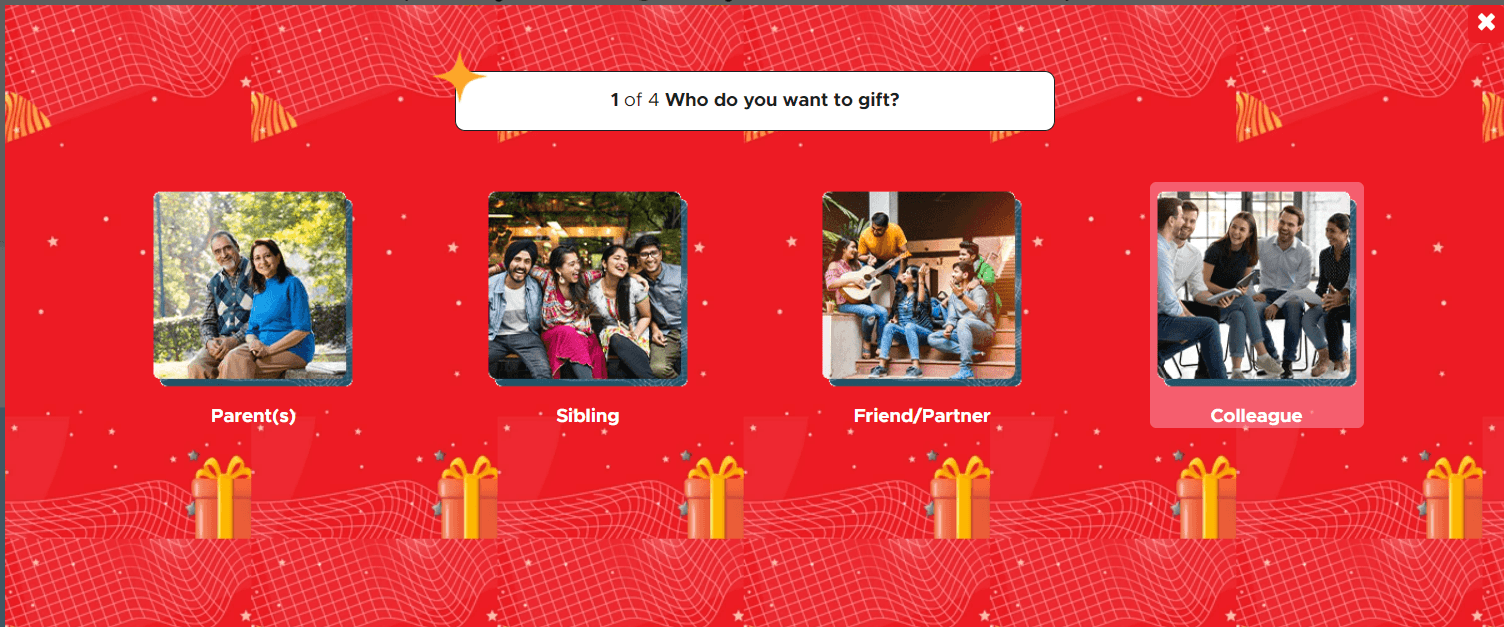
  • Introduced a dedicated Gifting section

  • Reduced friction in product discovery

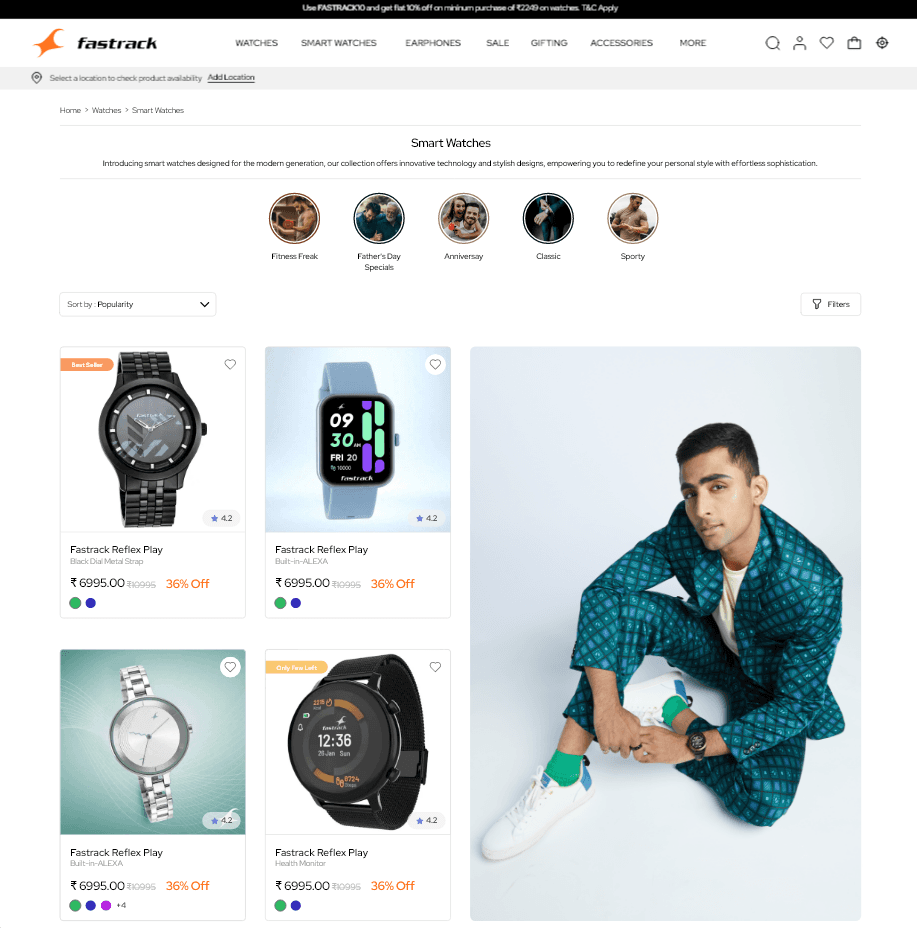
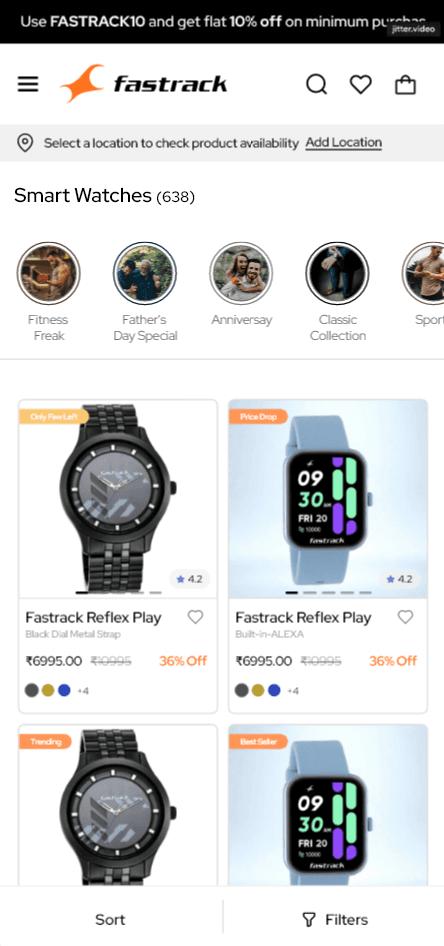
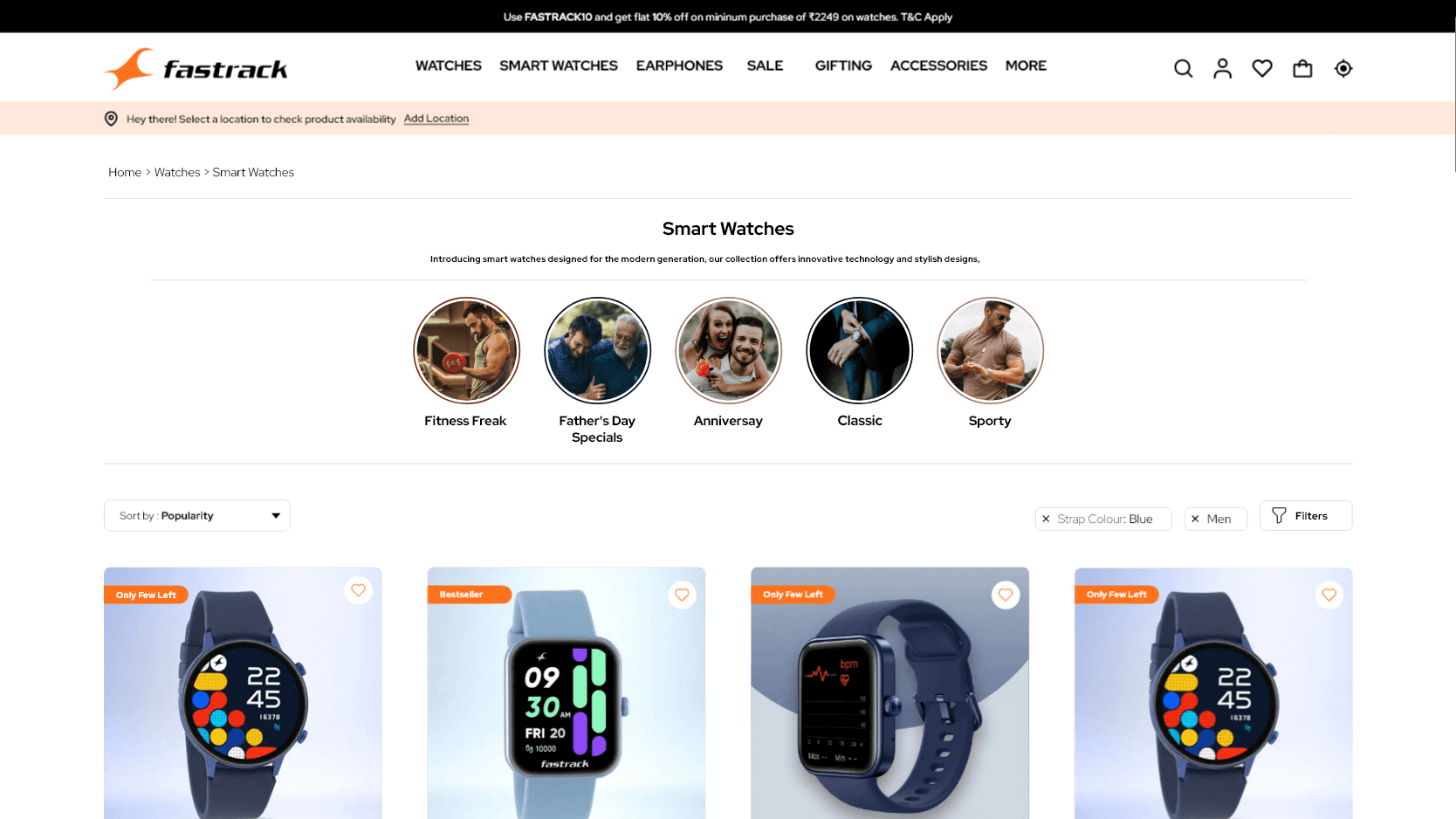
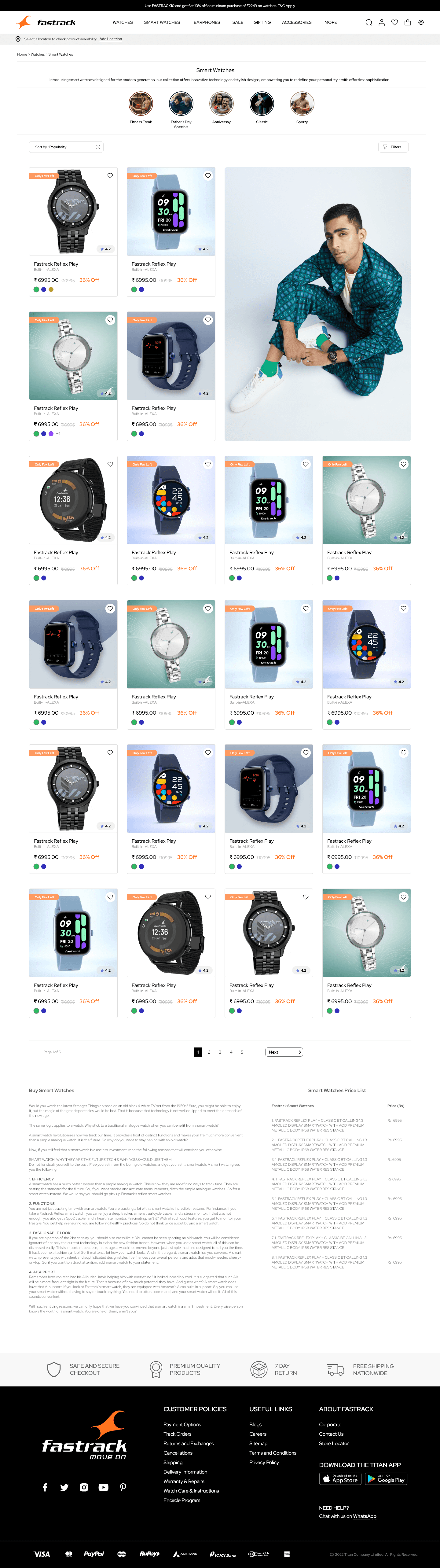
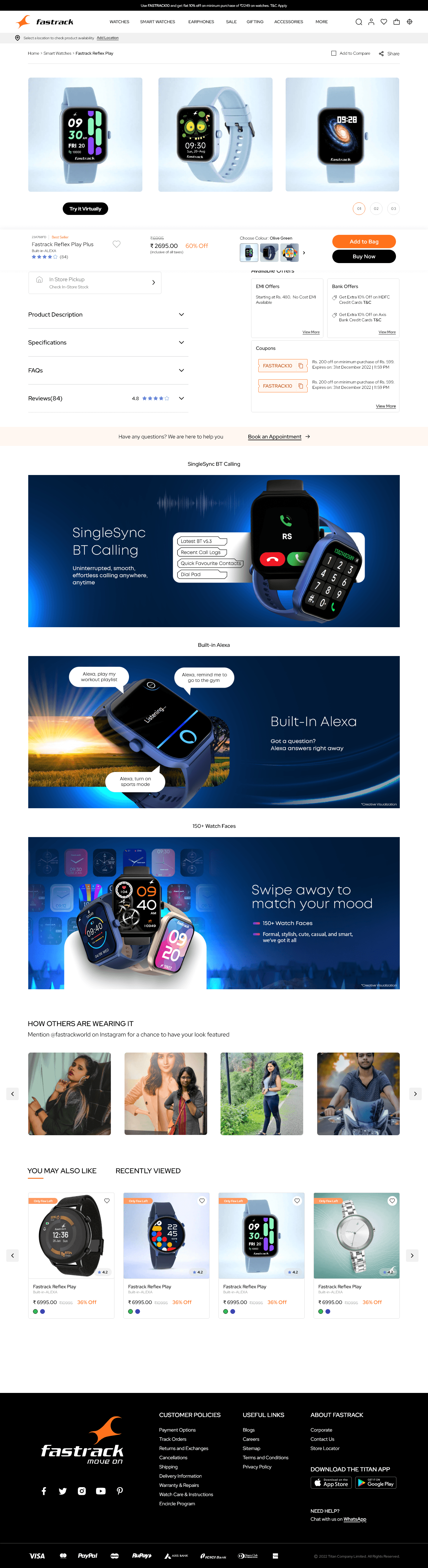
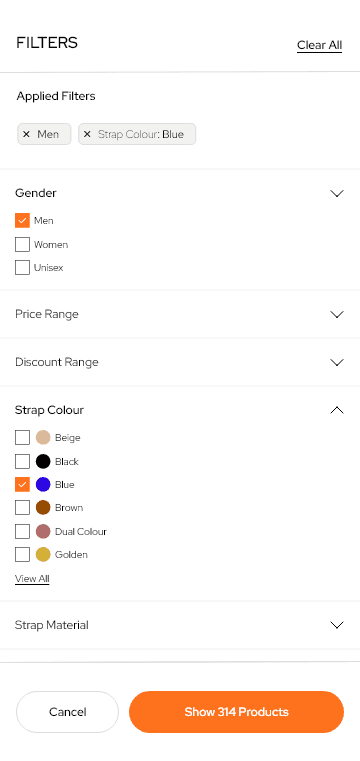
Introduced watch-specific product descriptions—tables for analog watches and visually led feature sections for smartwatches—to improve clarity and decision-making.

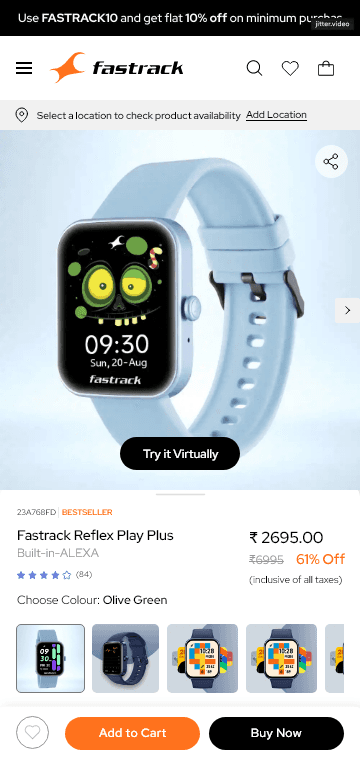
Simplified product naming: collection + key feature, with offer pricing and color variants highlighted upfront.
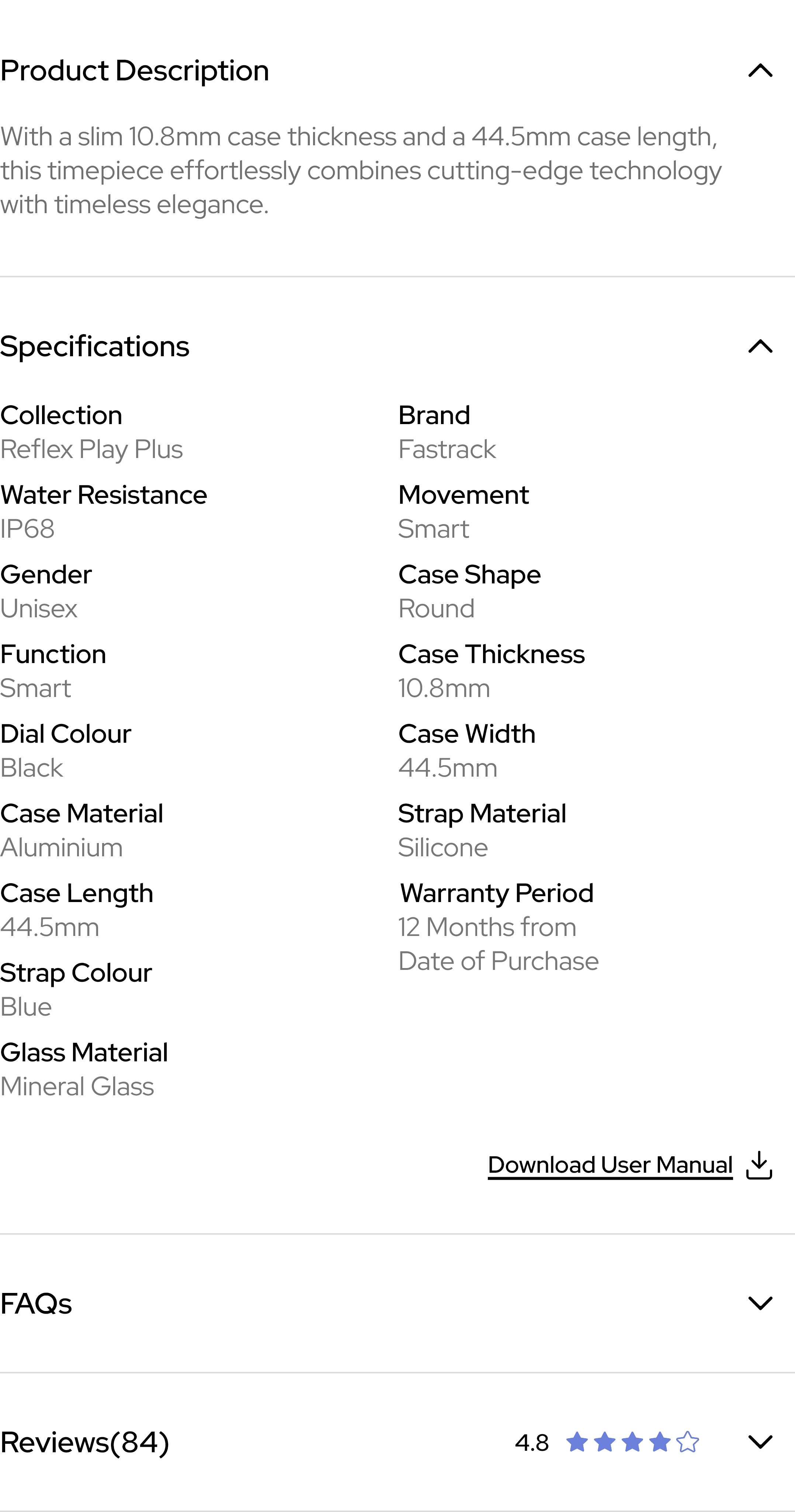
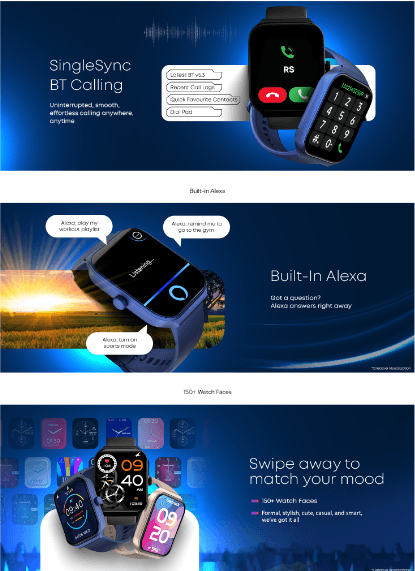
Introduced watch-specific product descriptions—tables for analog watches and visually led feature sections for smartwatches—to improve clarity and decision-making.

Simplified product information in PLP and PDP

User Scenario

Long product names and dense tables confused users.

Solution

  • Shortened product names (collection + key feature)

  • Visual feature highlights for smartwatches

  • Maintained SEO while improving scannability

Building trust & emotional connection

User Scenario

Users lacked trust and emotional connection with products due to limited social proof and real-life context.

Solution

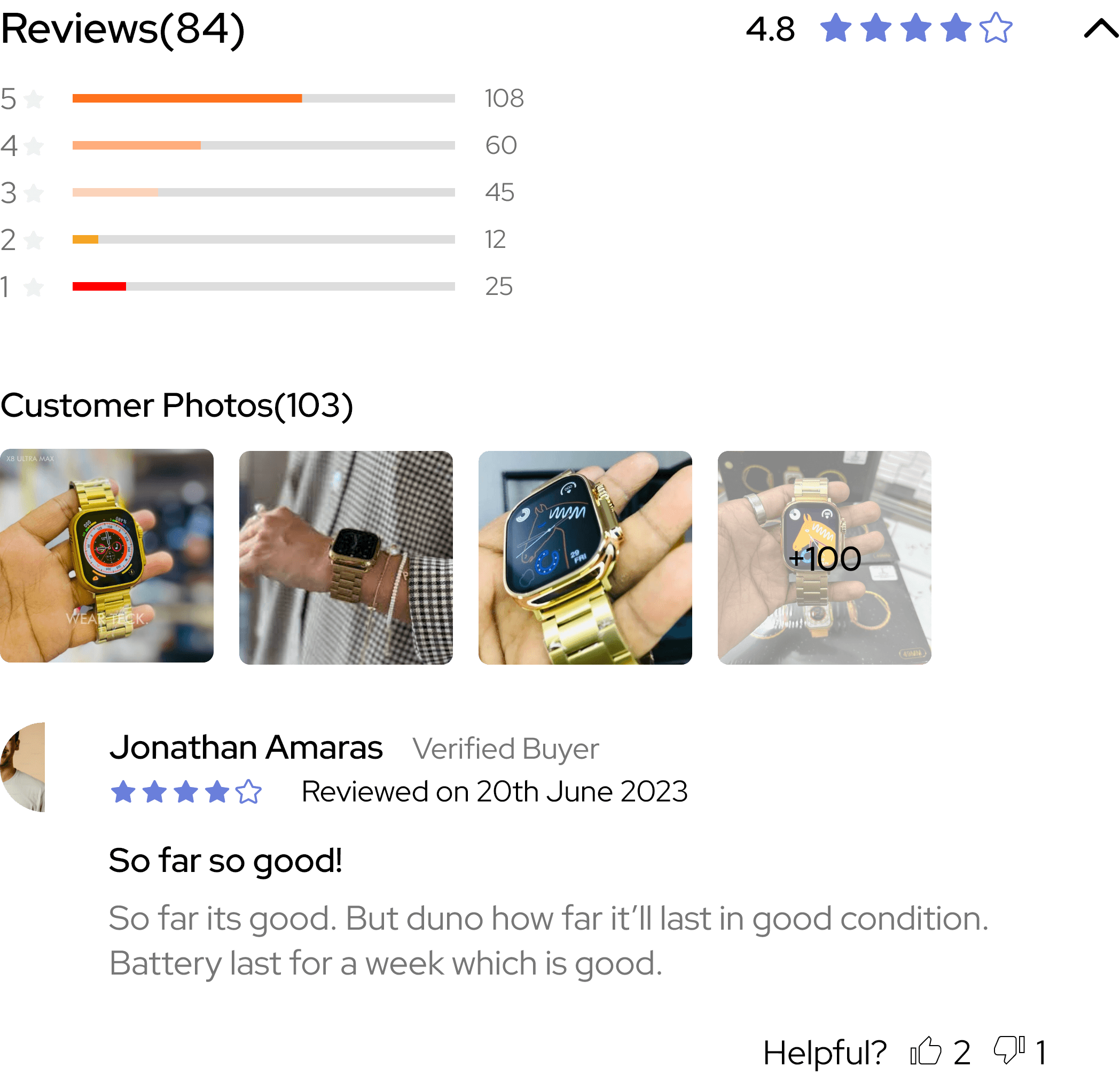
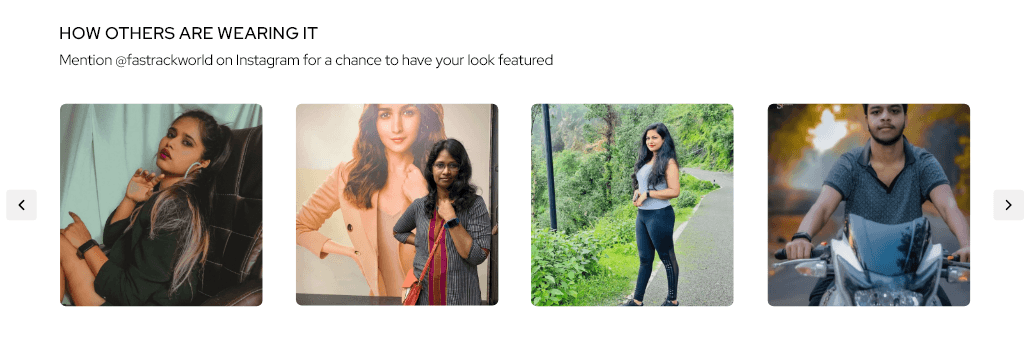
  • Integrated reviews, testimonials, and UGC

  • Showed products in real-life contexts.

Introduced watch-specific product descriptions—tables for analog watches and visually led feature sections for smartwatches—to improve clarity and decision-making.

Introduced watch-specific product descriptions—tables for analog watches and visually led feature sections for smartwatches—to improve clarity and decision-making.

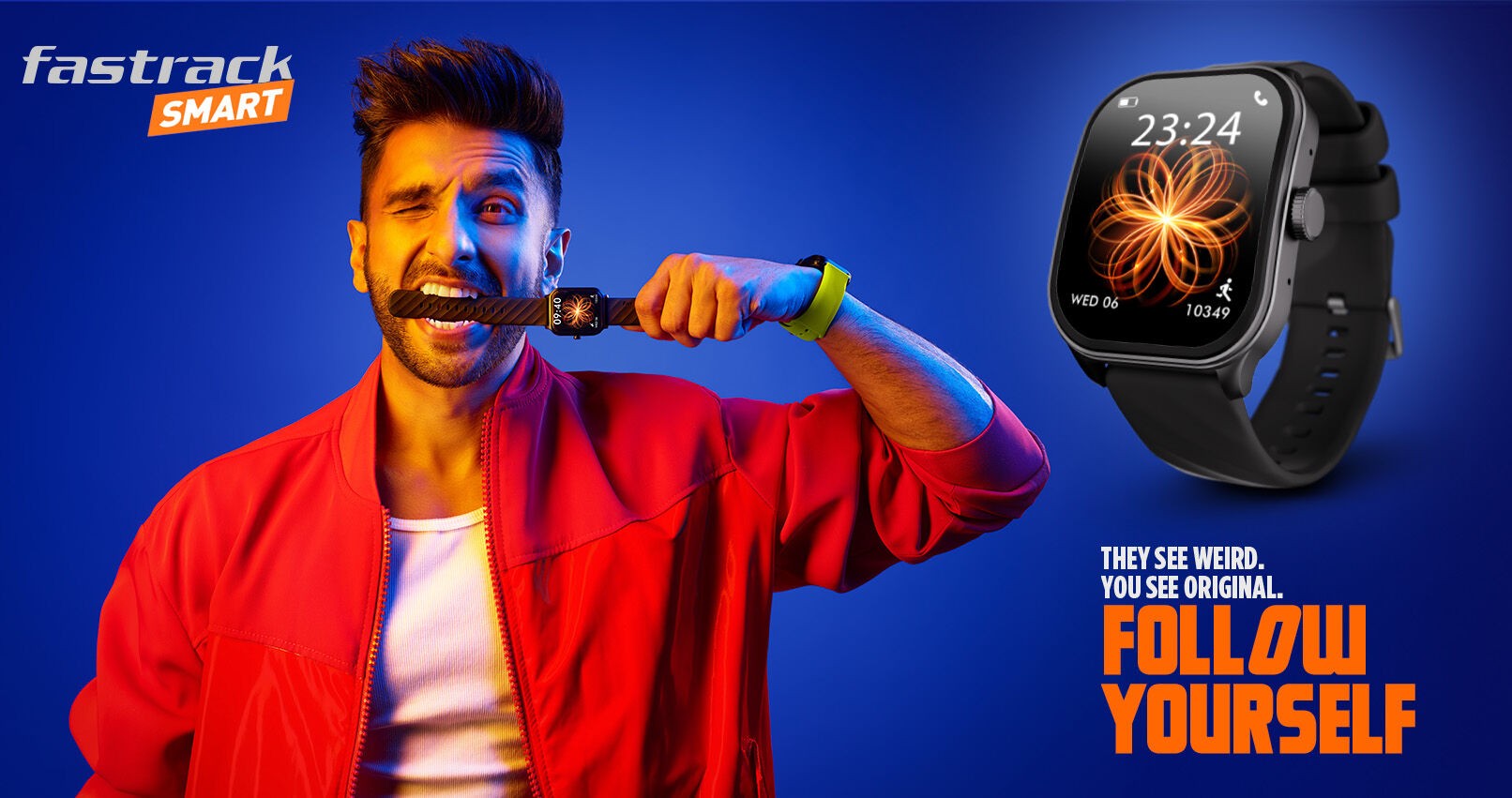
Celebrity-led storytelling

User Scenario

Marketing relied solely on product images, missing an emotional appeal to younger audiences

Solution

  • Shifted from static product imagery to lifestyle storytelling

  • Introduced Ranveer Singh as brand ambassador to connect with youth
Curated collections

User Scenario

Users visiting for specific needs, like gifting or sports, struggled with overwhelming options and decision fatigue.

Solution

  • Created occasion-based collections (e.g., Father’s Day, Sports)

  • Reduced decision fatigue and improved relevance.

Offer Visibility That Converts

User Scenario

Users often missed ongoing offers.

Solution

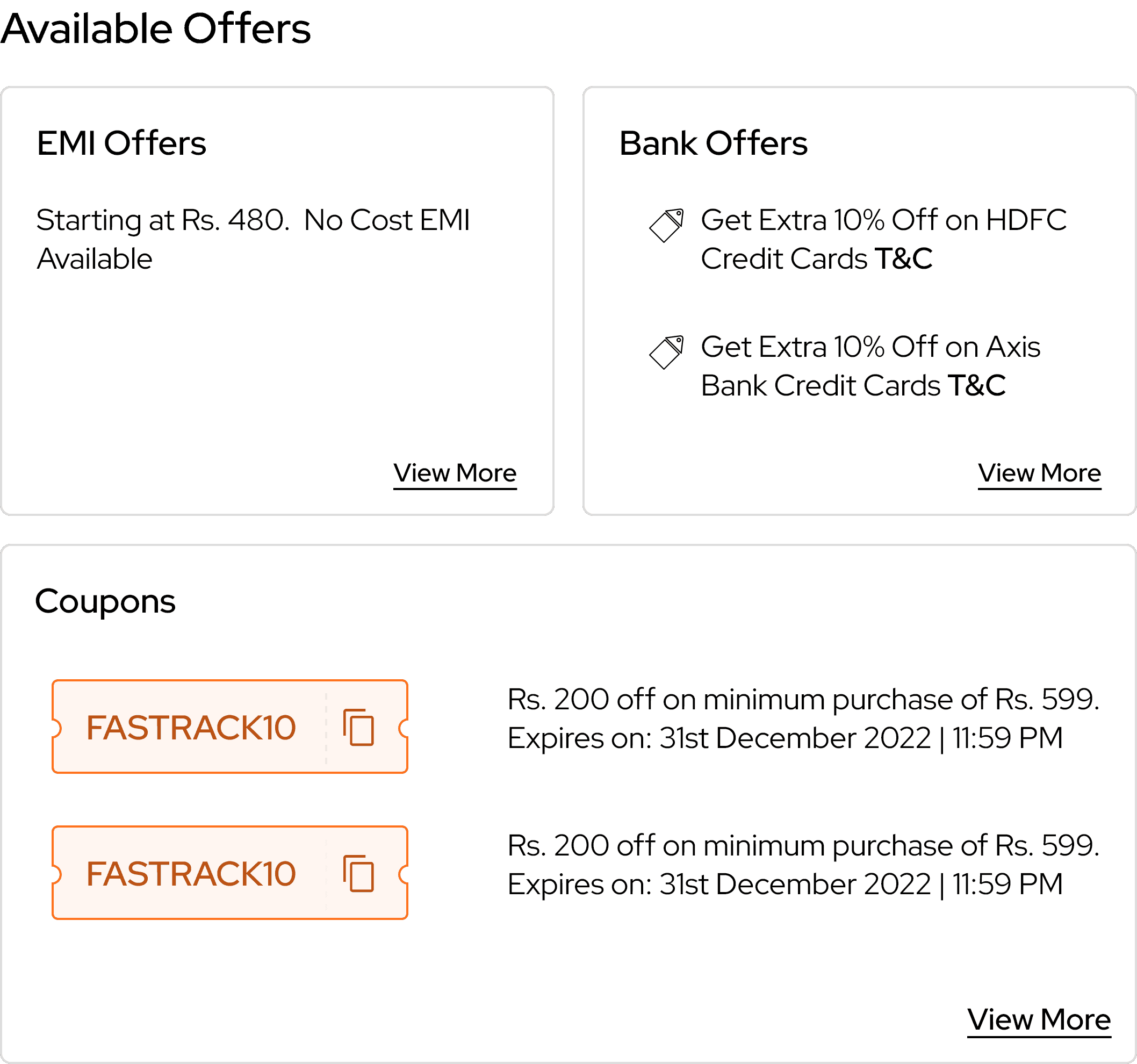
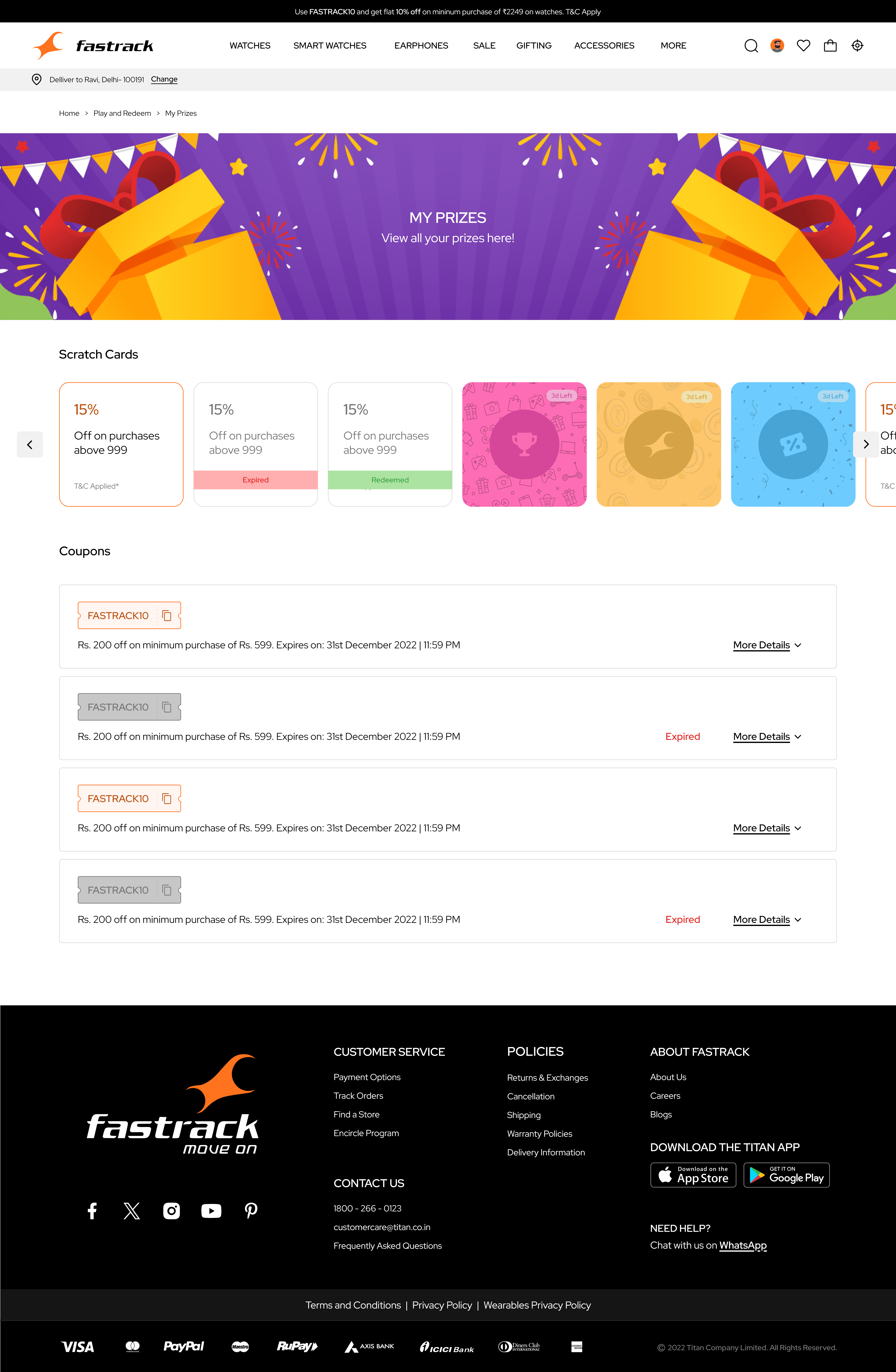
  • Highlighted discounts across homepage and PDP.

  • Balanced visibility without overwhelming the interface.

Playful & interactive experiences

User Scenario

Young, tech-savvy users seek a more engaging and dynamic browsing experience.

Solution

  • Interactive overlays for Product Comparison and Store Finder

  • Exploration-driven flows aligned with youth behavior

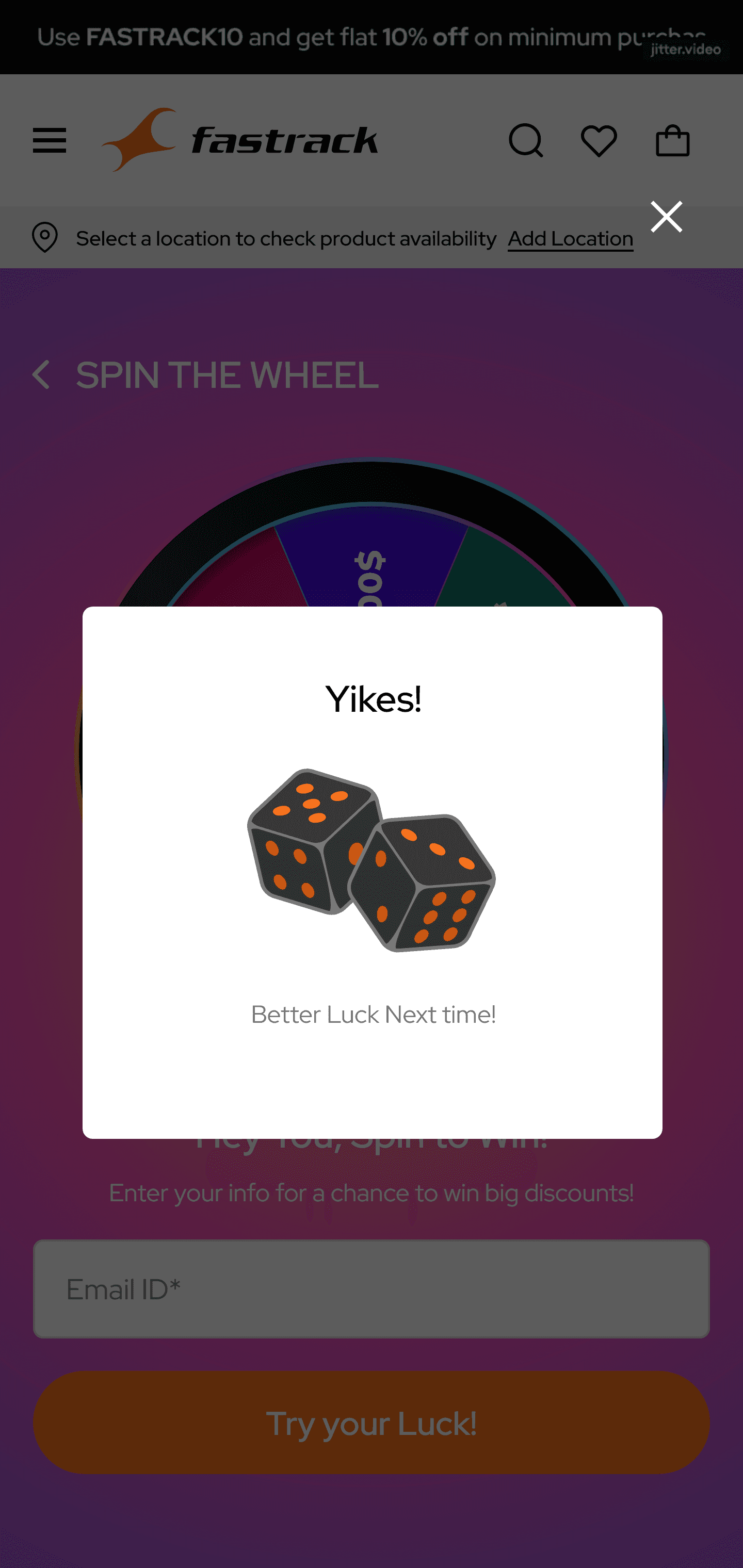
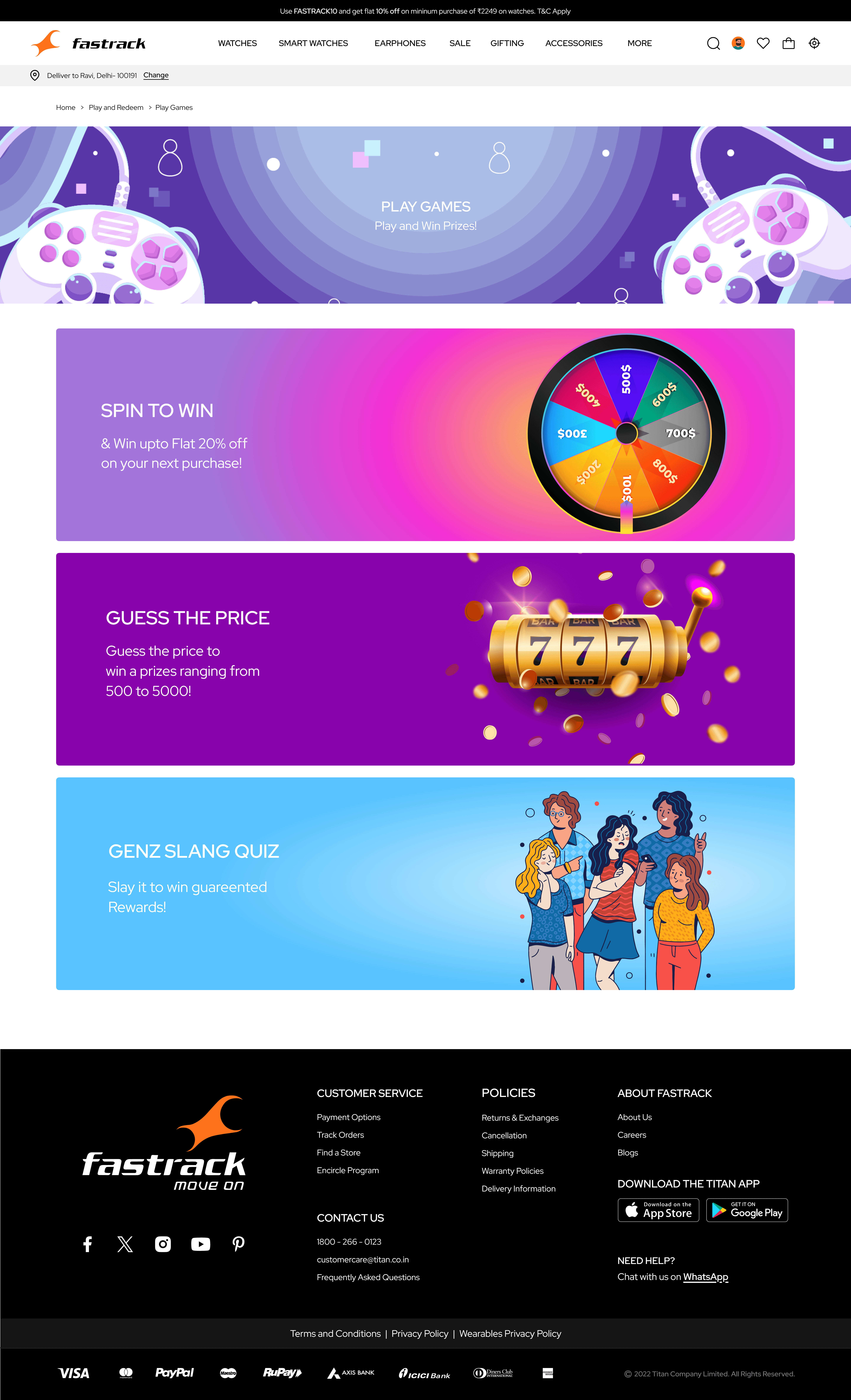
Gamified Engagement

User Scenario

Users needed a more engaging and interactive way to explore products and stay connected with the brand.

Solution

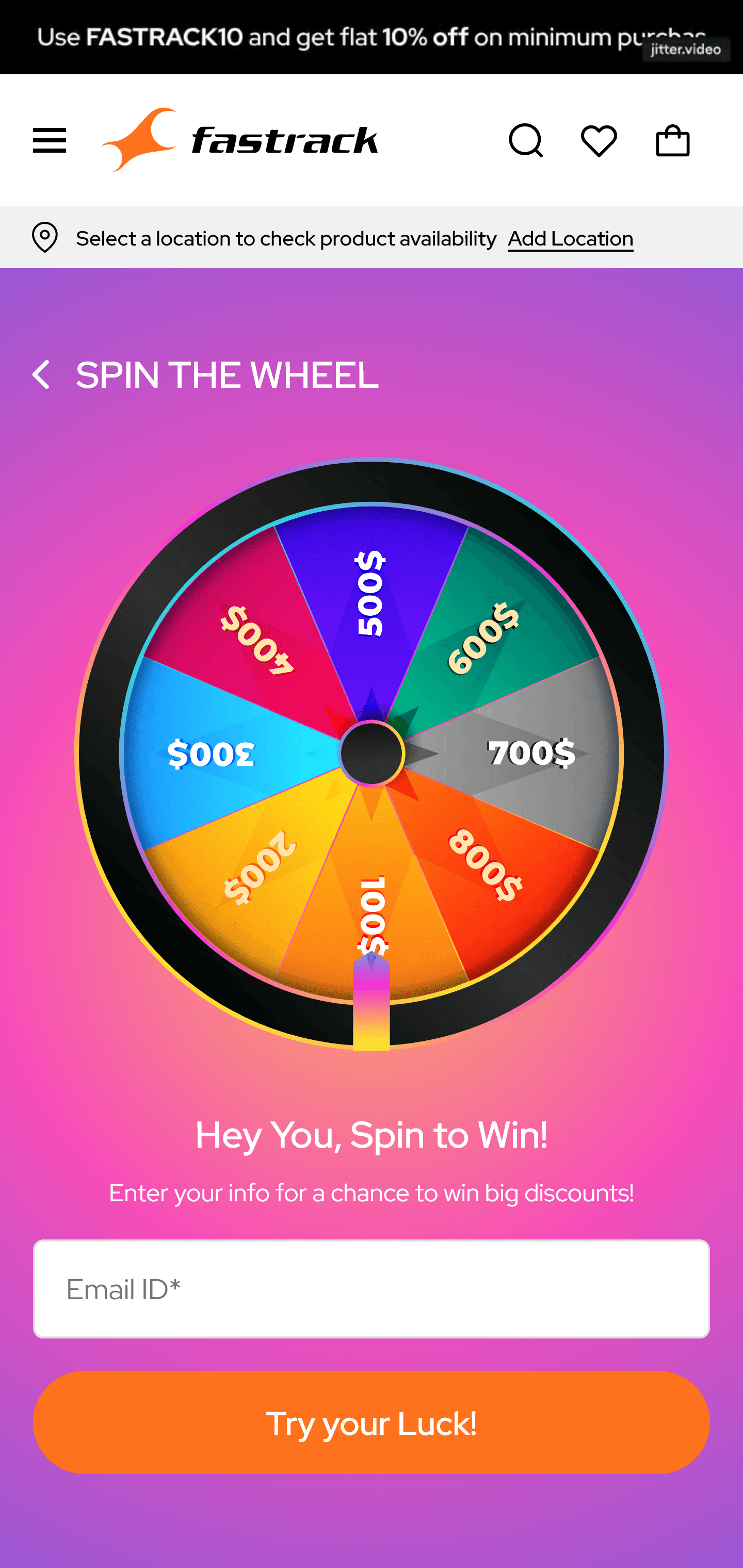
  • Quizzes

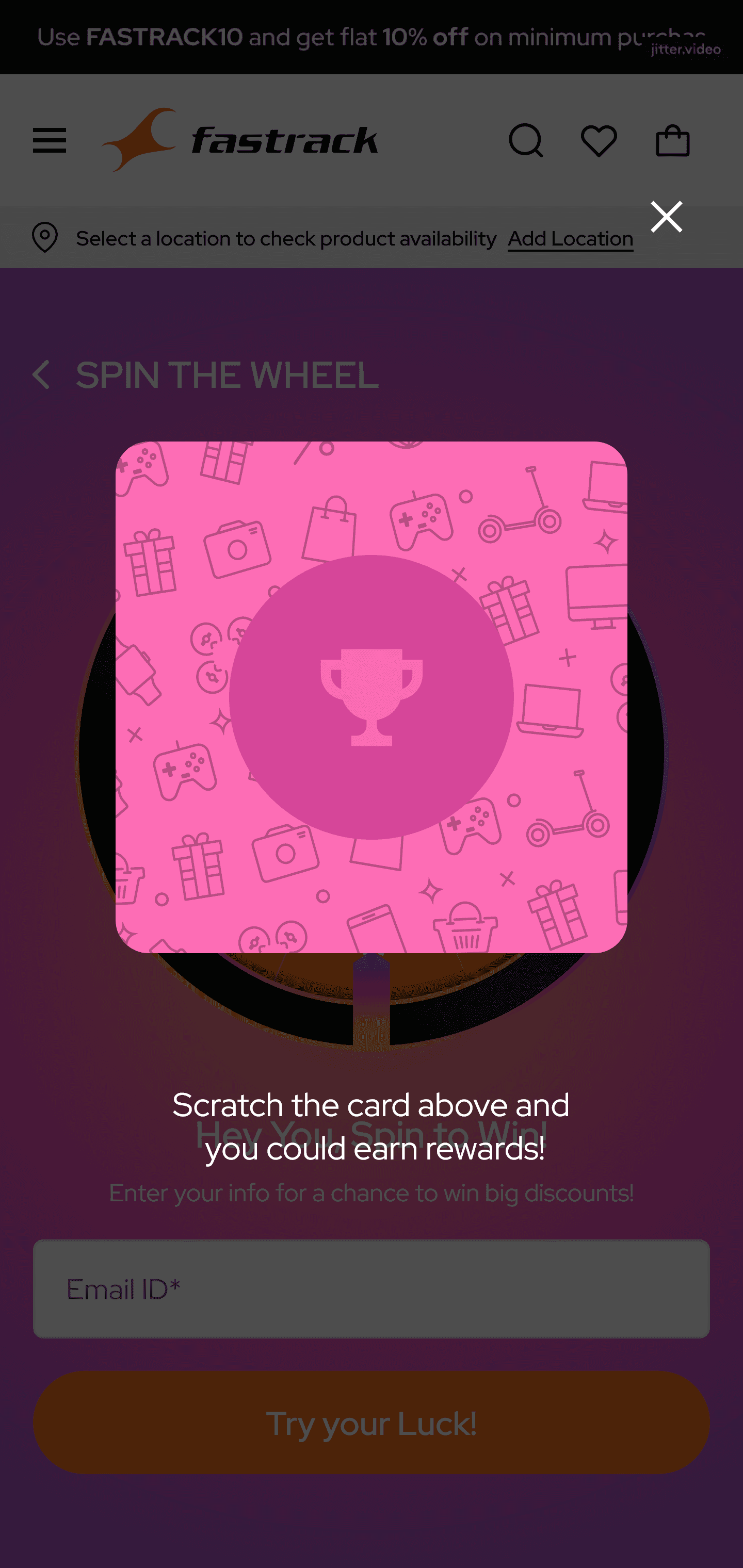
  • Spin-the-wheel rewards

  • Guess-the-price challenges

These increased engagement and strengthened brand recall.
More screens & highlights

Introduced watch-specific product descriptions—tables for analog watches and visually led feature sections for smartwatches—to improve clarity and decision-making.

Introduced watch-specific product descriptions—tables for analog watches and visually led feature sections for smartwatches—to improve clarity and decision-making.

Introduced watch-specific product descriptions—tables for analog watches and visually led feature sections for smartwatches—to improve clarity and decision-making.

Introduced watch-specific product descriptions—tables for analog watches and visually led feature sections for smartwatches—to improve clarity and decision-making.

Introduced watch-specific product descriptions—tables for analog watches and visually led feature sections for smartwatches—to improve clarity and decision-making.

Introduced watch-specific product descriptions—tables for analog watches and visually led feature sections for smartwatches—to improve clarity and decision-making.

Results

From here onwards, the Titan team assumed responsibility for testing and development, while maintaining constant communication with us throughout the process. Although our involvement was primarily in support tasks, the collaborative effort culminated in the release of the website's first phase on December 27th, 2023.


As testing continues and remaining features are integrated, the project progresses towards completion. Encouragingly, on April 1st, the Titan team shared positive KPIs indicating significant improvements

  • 📉 Reduced cart abandonment rate from 91.76% to 72.53%

  • 📈 Increased PDP visits from the homepage from 30.67% to 57.4%

These positive outcomes reflect our joint efforts in enhancing Fastrack's online presence and driving user engagement.

Explore other projects
Aifer Education

Edtech

Mobile

Open case study

Translation Tool

LangTech

SaaS

Open case study

Explore other projects
Aifer Education

Edtech

Mobile

Open case study

Explore other projects
Aifer Education

Edtech

Mobile

Open case study

© 2026 Sharon Pradeep. Hand-crafted in Figma & Framer

Built in Framer

© 2026 Sharon Pradeep. Hand-crafted in Figma & Framer

Built in Framer

© 2026 Sharon Pradeep. Hand-crafted in Figma & Framer

Built in Framer